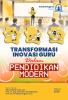
TRANSFORMASI INOVASI GURU dalam PENDIDIKAN MODERN
Keywords:
Transformasi Pendidikan Digital, Inovasi Guru, Kepemimpinan Digital, Integrasi Teknologi Pembelajaran, Budaya Kolaborasi GuruSynopsis
Buku Transformasi Inovasi Guru dalam Pendidikan Modern membahas perubahan paradigma pendidikan di era digital yang menuntut guru untuk beradaptasi, berinovasi, dan menjadi penggerak utama transformasi pembelajaran. Buku ini menguraikan dinamika pendidikan abad ke-21, tantangan profesi guru, peran teknologi, serta kompetensi yang diperlukan untuk menghadapi perkembangan zaman. Pembahasan diawali dengan konsep inovasi pendidikan dan posisi strategis guru sebagai agen perubahan dalam membangun budaya inovasi di lingkungan sekolah.
Selanjutnya, buku ini mengkaji pentingnya kepemimpinan digital, integrasi teknologi dalam pembelajaran, pemanfaatan kecerdasan buatan, serta penerapan berbagai platform digital untuk meningkatkan kualitas proses belajar mengajar. Selain itu, buku ini menyoroti peran Professional Learning Community (PLC), kolaborasi pengetahuan, dan komunitas praktisi sebagai fondasi pengembangan kompetensi guru secara berkelanjutan.
Melalui pendekatan integratif, buku ini menjelaskan keterkaitan antara karakter proaktif, growth mindset, kepemimpinan digital, dan budaya kolaborasi dalam membentuk profil guru masa depan. Model transformasi inovasi guru yang ditawarkan menjadi kerangka strategis bagi pendidik dan institusi pendidikan dalam menghadapi perubahan teknologi dan tuntutan pembelajaran modern. Buku ini diharapkan menjadi referensi akademik dan praktis bagi guru, calon guru, pemimpin pendidikan, serta pemangku kepentingan pendidikan dalam menciptakan ekosistem pembelajaran yang adaptif, inovatif, dan berkelanjutan
References
Admiraal, W., Schenke, W., De Jong, L., Emmelot, Y., & Sligte, H. (2021). Schools as professional learning communities: what can schools do to support professional development of their teachers? Professional Development in Education, 47(4), 684–698. https://doi.org/10.1080/19415257.2019.1665573
AlAjmi, M. K. (2022). The impact of digital leadership on teachers’ technology integration during the COVID-19 pandemic in Kuwait. International Journal of Educational Research, 112, 101928. https://doi.org/10.1016/j.ijer.2022.101928
Antinluoma, M., Ilomäki, L., & Toom, A. (2021). Practices of Professional Learning Communities. Frontiers in Education, 6. https://doi.org/10.3389/feduc.2021.617613
Birindelli, G., & Chiappini, H. (2021). Climate change policies: Good news or bad news for firms in the European Union? Corporate Social Responsibility and Environmental Management, 28(2), 831–848. https://doi.org/10.1002/csr.2093
Bond, M., Bedenlier, S., Marín, V. I., & Händel, M. (2021). Emergency remote teaching in higher education: mapping the first global online semester. International Journal of Educational Technology in Higher Education, 18(1), 50. https://doi.org/10.1186/s41239-021-00282-x
Connolly, C., O’Brien, E., & O’Ceallaigh, T. J. (2026). Ensuring Knowledge Sustainability in a Digital Era: Empowering Digital Transformation Through Digital Educational Leadership. Technology, Knowledge and Learning, 31(1), 175–191. https://doi.org/10.1007/s10758-023-09707-0
Costley, J. (2021). How role-taking in a group-work setting affects the relationship between the amount of collaboration and germane cognitive load. International Journal of Educational Technology in Higher Education, 18(1), 24. https://doi.org/10.1186/s41239-021-00259-w
Díaz-Gibson, J., Daly, A., Miller-Balslev, G., & Zaragoza, M. C. (2021). The SchoolWeavers tool: supporting school leaders to weave learning ecosystems. School Leadership & Management, 41(4–5), 429–446. https://doi.org/10.1080/13632434.2020.1770210
Dwivedi, Y. K., Hughes, D. L., Coombs, C., Constantiou, I., Duan, Y., Edwards, J. S., Gupta, B., Lal, B., Misra, S., Prashant, P., Raman, R., Rana, N. P., Sharma, S. K., & Upadhyay, N. (2020). Impact of COVID-19 pandemic on information management research and practice: Transforming education, work and life. International Journal of Information Management, 55, 102211. https://doi.org/10.1016/j.ijinfomgt.2020.102211
King, R. B., Lou, N. M., & Barger, M. (2026). Expanding growth mindset research to fulfill its promise in education: international perspectives. Social Psychology of Education, 29(1), 62. https://doi.org/10.1007/s11218-026-10213-1
Lambriex-Schmitz, P., Van der Klink, M. R., Beausaert, S., Bijker, M., & Segers, M. (2020). Towards successful innovations in education: Development and validation of a multi-dimensional Innovative Work Behaviour Instrument. Vocations and Learning, 13(2), 313–340. https://doi.org/10.1007/s12186-020-09242-4
Laura Icela, G.-P., María Soledad, R.-M., & Juan Antonio, E.-G. (2023). Education 4.0 Maturity Models for Society 5.0: Systematic literature review. Cogent Business & Management, 10(3). https://doi.org/10.1080/23311975.2023.2256095
Mabunda, P. L., & McKay, V. I. (2024). Navigating the First Years: Newly Qualified Teachers’ Experiences with Professional Learning Communities. Systemic Practice and Action Research, 37(6), 1281–1302. https://doi.org/10.1007/s11213-024-09707-w
Magistretti, S., Allo, L., Verganti, R., Dell’Era, C., & Reutter, F. (2021). The microfoundations of design sprint: how Johnson & Johnson cultivates innovation in a highly regulated market. Journal of Knowledge Management, 25(11), 88–104. https://doi.org/10.1108/JKM-09-2020-0687
Mockeviciene, I., Karcauskiene, D., Slepetiene, A., Vilkiene, M., Repsiene, R., Braziene, Z., & Anne, O. (2022). Influence of Liming Intensity on Fractions of Humified Organic Carbon in Acid Soil: A Case Study. Sustainability, 14(9), 5297. https://doi.org/10.3390/su14095297
Olabiyi, O. J., Vuuren, C. J. van, Du Plessis, M., Xue, Y., & Zhu, C. (2025). Digital Academic Leadership in Higher Education Institutions: A Bibliometric Review Based on CiteSpace. Education Sciences, 15(7), 846. https://doi.org/10.3390/educsci15070846
Pan, B., Song, Z., & Wang, Y. (2021). The Relationship Between Preschool Teachers’ Proactive Personality and Innovative Behavior: The Chain-Mediated Role of Error Management Climate and Self-Efficacy. Frontiers in Psychology, 12. https://doi.org/10.3389/fpsyg.2021.734484
Parker, C., & Bickmore, K. (2023). Corrigendum to “Classroom peace circles: teachers’’ professional learning and implementation of restorative dialogue” [Teachingand Teacher Education 95 (2020) 103129].” Teaching and Teacher Education, 121, 103873. https://doi.org/10.1016/j.tate.2022.103873
Pietsch, M., & Mah, D.-K. (2025). Leading the AI transformation in schools: it starts with a digital mindset. Educational Technology Research and Development, 73(2), 1043–1069. https://doi.org/10.1007/s11423-024-10439-w
Shal, T., Ghamrawi, N., Abu-Tineh, A., Al-Shaboul, Y. M., & Sellami, A. (2024). Teacher leadership and virtual communities: Unpacking teacher agency and distributed leadership. Education and Information Technologies. https://doi.org/10.1007/s10639-023-12446-5
Stenbom, S., & Geijer, L. (2025). Primary school teachers’ perception of digital transformation and their teaching role. Scandinavian Journal of Educational Research, 69(5), 1131–1144. https://doi.org/10.1080/00313831.2024.2394395
Ushaka Adie, B., Tate, M., & Valentine, E. (2024). Digital leadership in the public sector: a scoping review and outlook. International Review of Public Administration, 29(1), 42–58. https://doi.org/10.1080/12294659.2024.2323847
Widayati, A., MacCallum, J., & Woods-McConney, A. (2021). Teachers’ perceptions of continuing professional development: a study of vocational high school teachers in Indonesia. Teacher Development, 25(5), 604–621. https://doi.org/10.1080/13664530.2021.1933159
Published
License

This work is licensed under a Creative Commons Attribution-NonCommercial-ShareAlike 4.0 International License.